What will you learn about?
Why Space and Bicycles?
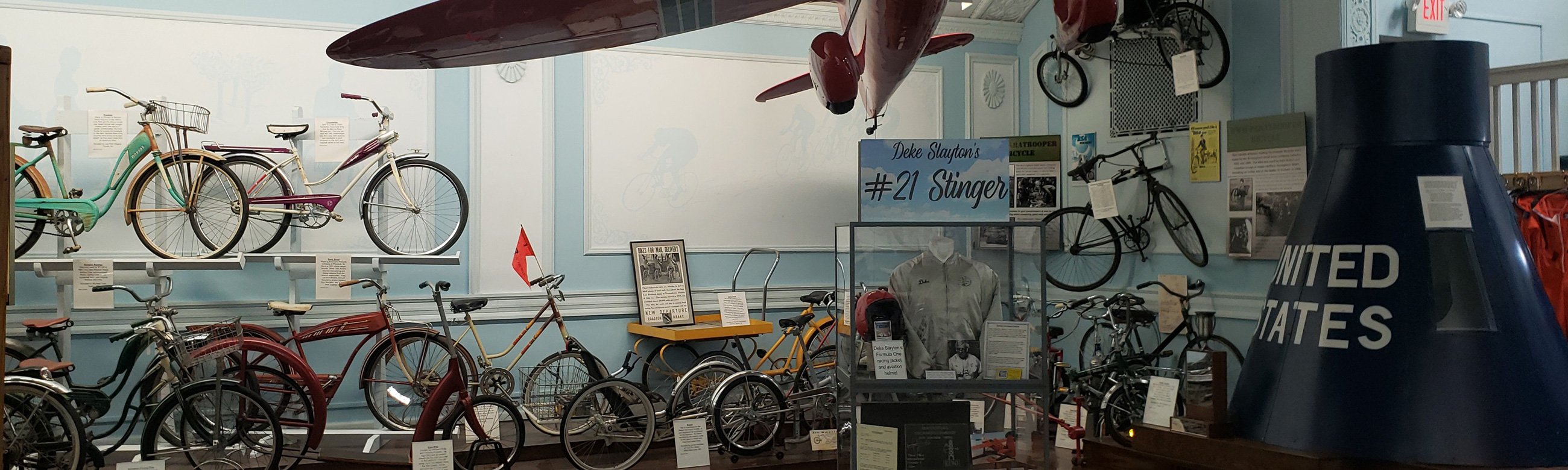
Sparta, Wisconsin is the "Bicycling Capital of America" because it is home to the Elroy-Sparta Bike Trail, the first Rails-to-Trails in the country in which unused railroad lines are converted into bike trails. Before the Wright brothers made history with their first flight in 1903, they owned a bicycle shop and used bicycle components in their first airplane. Deke Slayton is a Sparta native, and one of America's first astronauts—part of the Mercury 7 group formed by NASA in 1959. We combine these topics into a "Progression of Transportation" story starting with bicycles, going on to planes, and into space!
Evolution Of the Bicycle

Historians generally agree that Baron Karl von Drais of Germany made the first prototype that evolved into the bicycle we have today. He unveiled his “hobby-horse” or “Draisine” to the public in 1817. It was propelled solely by the rider’s feet because it had no pedals and was originally invented to replace the horse. With various public exhibitions, he proved that travel time could be cut in half or better, depending on the roads. Despite the advanced travel time it provided, the Draisine never gained great popularity.
In 1867, Pierre Michaux of Paris, France designed a bicycle with pedals and cranks attached to the front wheel. He called it the “velocipede,” and people began to ride different versions of this bicycle throughout cities in Europe. His machine was made completely of metal and weighed about 70 pounds. Despite some versions of the velocipede that had seats supported by springs, the construction of this model made the ride extremely uncomfortable, and it gained the title of “boneshaker.”

1885 Champion high wheel bicycle on display in museum
By the 1880s, the “penny-farthing” or “high wheel” evolved as the next bicycle design, and it gained great popularity around the world, especially in Britain. The high wheel’s unique design enabled it to go farther with each revolution of the front wheel and thus travel was even faster—although riding it on poor roads was extremely dangerous. Safety was an issue with the high wheel, and despite the high speeds it could reach, the bike eventually fell out of favor because of the severe injuries sustained by many of its riders.
When both wheels on the bicycle became the same size, usually 28 or 29 inches, and were driven by a chain sprocket, the “safety bicycle” was born. Improvements such as air-filled rubber tires and brakes helped create a bicycling craze. Bicycling became so popular by the 1890s that many machine shops began to manufacture bicycles. Chicago alone had about 400 makers at the height of demand. Bicycling became more accessible for women, and it played a significant role in the women’s rights movement. The safety bicycle is the model that most of our current bicycles take after today.

2004 Schwinn Stingray Orange County Chopper on display in museum
Over time, not only did the bicycle evolve, but it was adapted to fulfill different functions. Folding paratrooper bicycles were used in World War II. Cargo cycles were created to transport goods. Ice bicycles were crafted to travel in extremely cold environments. Tandem bicycles were made to accommodate multiple riders. Fiberglass bicycles were designed to weigh very little but be very strong.
Bicycles demonstrate that there is truly no limit to human ingenuity. Visit the museum and explore our amazing bicycle collection spanning from the Draisine to a Schwinn Chopper!

- 1790 – Celerifere
- 1817 – Draisienne or Laufmaschine
- 1818 – Johnson’s Ladies Walking Machine
- 1820 – Reproduction of Draisienne
- 1866 – Serpentine Velocipede
- 1869 – Michaux Velocipede/ Boneshaker
- 1871 – Penny Farthing
- 1879 – Lawson Bicyclette
- 1885 – Starley Rover
- 1942 – B.S.A Folding Bicycle
- 1960 – Schwinn Panther III
- 1988 – Schwinn Paramount – 50th Anniversary Limited Edition
- 2008 – Yamaha PAS (Power Assist System) Brace Electric Bike
Aviation

"Wright Flyer" model on display in museum
The idea of flight has intrigued humans for thousands of years, but it was not until Orville and Wilbur Wright achieved the first controlled, sustained, powered flight that humans truly conquered the skies. On December 17, 1903, the Wright brothers changed the world. The brothers and their airplane, the Wright Flyer, made four flights that day before crashing. The longest lasted 59 seconds and traveled 852 feet (that is about 2.5 football fields). Prior to making history, the brothers owned a bicycle shop which was critical to the building of their Wright Flyer. They used bicycles to simulate a wind tunnel to develop the wings and used bicycle components in the airplane’s design.
Militaries in Europe and the United States quickly saw the tactical benefits of airplanes and began using them as early as 1911. Italy was the first country to use airplanes for reconnaissance and bombing during the Italian-Turkish War. World War I, which began in 1914, was the first war to see use of airplanes for offense, defense, and reconnaissance. Both the Allies and Central Powers used airplanes. The addition of a fixed machine gun to the front of airplanes gave rise to the “flying ace,” the “Red Baron” being the most famous.

In the years between World War I and World War II, 1918-1939, airplanes evolved tremendously. Some of the changes included: aluminum parts rather than wood and fabric, they became bigger and more powerful, fixed-wing monoplanes were introduced, flight instruments were developed, rotors were invented leading to the creation of the helicopter, and jet engines were fabricated. Air shows featuring air racing and acrobatic stunts became popular in the United States, and this racing drove engine and airframe development even more, due to the constant need to fly faster and farther. One of the most famous air show pilots was Amelia Earhart. The introduction of air mail service also pushed development in the United States.

The extensive use of aircraft during World War II, 1939-1945, greatly increased the production and development of both airplanes and helicopters. Because airplanes were used in all areas of warfare, there was a need for large and small bombers, fighter escorts, ground-attack aircraft, radar, and flight-based weapon delivery systems.
Commercial aviation began in the 1920s, but it really boomed after World War II. Large ex-military bombers were easy to convert to carry passengers and cargo. Air travel was faster and less expensive than ocean liners and trains, so it became the preferred method of travel. This caused the performance of the jet engine to rapidly improve. Jet airliners could now fly across the ocean non-stop. The improved jet engine greatly benefited helicopters providing them more power and flexibility. There was also an increased demand for personal and utility airplanes expanding the “light plane industry.” With the growing number of people flying either commercially or privately, aviation electronics such as navigation, instrumentation, communication, safety, and landing assistance had to quickly improve.

Throughout the Space Race of the late 1950s and 1960s, satellites, rockets, spacecraft, and the moon lander were introduced. Humans traveled 250,000 miles and landed on the moon in 1969—only 66 years after the Wright brother’s first airplane flight. To commemorate this achievement, Neil Armstrong took with him to the moon a piece of fabric and wood from the original Wright Flyer. A piece of this fabric is on display in the Deke Slayton Memorial Space & Bicycle Museum.
The digital age influenced aircraft electrical systems such as navigation, displays, and individual functions management. It has even influenced the need for a pilot! In 2001, Global Hawk, a remotely piloted surveillance aircraft, flew from California to Australia non-stop, and 2003 marked the first autonomous flight across the Atlantic Ocean by a computer-controlled model plane. Solar and electric planes have also been invented.
Aviation is an important piece of the “Progression of Transportation” story we tell at the museum. Not only did the first airplane have bicycle components, but America’s original astronauts—including Deke Slayton—were all pilots. On display in the museum, you will find models, a hang glider, and two full-size airplanes: a 1932 Pietenpol and Deke Slayton’s Formula 1 racing plane, the Stinger.

Deke Slayton’s “Stinger” on display in museum
About Deke Slayton

Lieutenant Donald K. Slayton, Army Air Corps, 1943
Donald Kent “Deke” Slayton was born on March 1, 1924, to a local farming family in Leon, just outside of Sparta, Wisconsin. Growing up, Deke knew he wanted to do something different with his life other than farming. Pearl Harbor was bombed during Deke’s senior year in high school, and after graduation from Sparta High School in 1942, he joined the Army Air Corps and became a pilot.
During WWII, he flew 56 combat missions in Europe and 7 in Japan. After the war, he attended the University of Minnesota under the GI Bill and graduated in 2.5 years with a degree in aeronautical engineering. Finding civilian life and employment a bit dull, he applied for a commission in the Air Force after the Korean War began. In 1955, after a 3-year stint in Germany, Deke transferred to Edwards Air Force Base in California and became a test pilot for new prototype airplanes.
Back home in Wisconsin, Deke was always called Don, but at Edwards there was another pilot also named Don in his class. To differentiate the two, the nickname “Deke” developed as a combination of his first and middle initials (DK). While Deke was at Edwards, the Russians launched the satellite Sputnik. As a result, Deke was requested to report to Washington, D. C. for a classified briefing. The idea of “astronauts” was formed, and the Space Race began.

In his Mercury spacesuit 1962, suit is on display in museum, photo by Bill Taub
After months of extensive testing, the newly formed National Aeronautics and Space Administration (NASA) narrowed down the pool of military test pilots from 508 to just seven. Having survived the rigorous tests and requirements, Deke Slayton became one of America’s first astronauts—part of the Mercury 7 group that was introduced to the world in April 1959.
Deke was thrilled and excited to be part of this new challenge and adventure. Over the next three years, Deke distinguished himself and was slated to be the fourth American in space. However, during routine medical tests, doctors found a very slight irregularity in his heartbeat. After much debate amongst NASA officials and intense political pressure, Deke was taken off active flight duty and grounded.
Deke was devastated, but always the team player, he stayed on at NASA and became Coordinator of Astronaut Activities and then Director of Flight Crew Operations. Deke proved to be an excellent leader and was instrumental in choosing the next six classes of astronauts, overseeing their training, and designating the crews for missions. He put the right people in the right places at the right times. It was Deke Slayton who chose Neil Armstrong to be the first person to walk on the moon.

In docking module during ASTP mission, 1975
Thanks to a healthier lifestyle, Deke’s irregular heartbeat went away. After 10 years on the ground, he was restored to active flight status. Deke was assigned to the Apollo-Soyuz Test Project (ASTP) mission, a joint mission between the United States and the Soviet Union, and the first international docking mission. This mission would pave the way for all future space cooperation with the Soviet Union, including the International Space Station and American astronauts flying on Soviet Soyuz spacecraft following the retirement of the Space Shuttle.
After 3 years of training, including learning Russian, the American Apollo and Soviet Soyuz space vehicles launched on July 15, 1975. They docked together in space two days later. At 51 years old, Deke joked about being “the oldest rookie” ever to go into space. As the two crews orbited Earth, they signed ceremonial documents, shared meals, did scientific experiments, and held press conferences. While in space, they received a call from President Ford, who asked Deke if he had any advice for school children, to which he replied, “Decide what you want to do, and never give up until you’ve done it.”
Following the completion of ASTP, Deke transfered to the Space Shuttle program where he managed the Approach and Landing Tests (ALT), assisted in the development of the Shuttle Carrier Aircraft, and managed the Orbital Flight Tests (OFT). He retired from NASA in 1982. Deke Slayton is the only astronaut to have been part of the Mercury, Gemini, Apollo, Skylab, ASTP, and Space Shuttle programs.

Official NASA Space Shuttle photo, 1979
Despite his retirement, Deke continued to participate in space and aviation. He became the president of Space Services Inc, a company in Houston, Texas, that developed rockets for small commercial payloads. He was the Mission Director for their Conestoga 1 rocket, which launched on September 9, 1982, becoming the world’s first privately funded rocket to reach space. He also bought a Formula 1 racing plane, the Stinger, and became involved in both racing and serving as president of International Formula 1 Pylon Air Racing. The Stinger is hanging in our museum gallery.
After a full life and exciting career, Deke Slayton succumbed to brain cancer on June 13, 1993, at the age of 69. In honor of Deke’s love of flying, the family asked two of his pilot friends to release his ashes out of their airplane over the Slayton family farm in Leon, Wisconsin.
Click to watch “Space and Things” podcast interview featuring Deke Slayton’s son, Kent Slayton, and museum director, Alyssa Young
Moon Rock
The Deke Slayton Memorial Space & Bicycle Museum is home to the only viewable piece of moon rock in the entire state of Wisconsin! It is on display as part of the Ambassador of Exploration Award, which not only honors Deke Slayton, but the entire space exploration legacy.
To commemorate the 35th anniversary of human exploration of the moon, NASA created the Ambassador of Exploration Award in 2004. Recipients of the award include all astronauts from the Mercury, Gemini, and Apollo missions in recognition of their dedication and sacrifice for the national goal of space exploration.
Each award recipient selected a museum or other educational institution where their award is publicly displayed in their name to help inspire a new generation of explorers.
In 2006, Deke Slayton’s Ambassador of Exploration Award was posthumously bestowed to his widow, Bobbie Slayton, who chose the Deke Slayton Memorial Space & Bicycle Museum as the permanent home for the award. Over the years, our piece of the moon has been seen and enjoyed by tens of thousands of visitors, inspiring people from all walks of life.

Maybe someday we will all be riding bicycles in space!
